A clear, broker-style guide to preparing a mortgage application as a self-employed borrower in Manchester and Greater Manchester, including what lenders look for and how to get your paperwork in order.
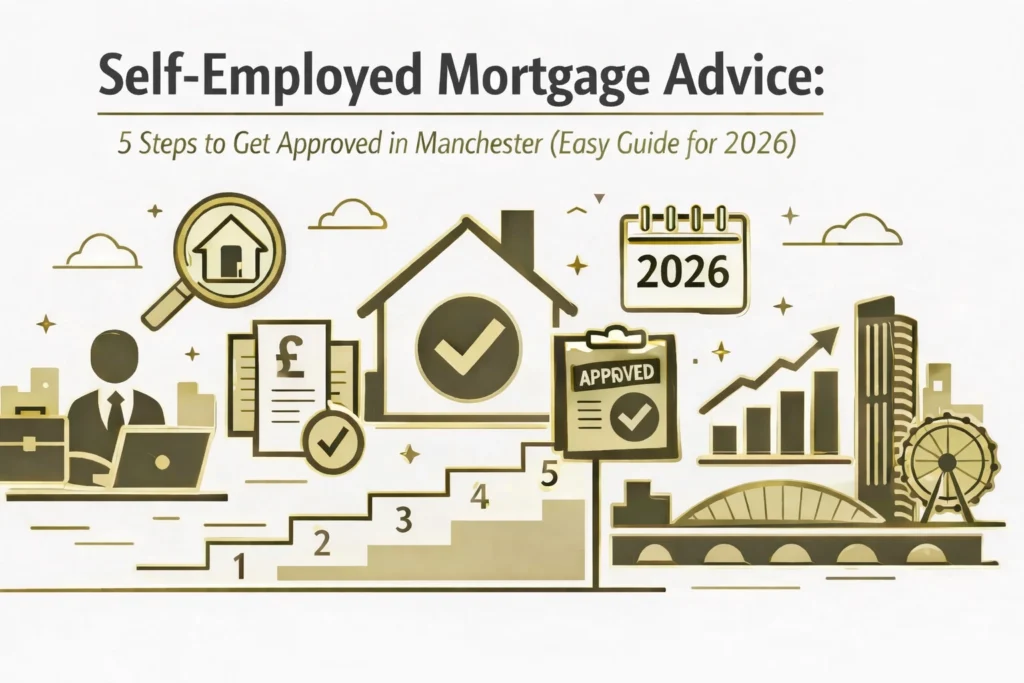
Self-employed mortgage advice in Manchester: a practical 5-step guide
Why self-employed mortgages can feel harder
When you’re self-employed, your income doesn’t always look like a simple payslip. Lenders can’t verify your earnings through an employer, so they rely on the evidence you provide.
That’s why mortgage applications for self-employed borrowers often involve more paperwork and more scrutiny—especially around whether your income is genuine, consistent, and likely to continue.
The good news: if you prepare the right documents in the right order, you can make the process far smoother.
This guide focuses on what typically matters for self-employed mortgage applications across Manchester, Wigan, Bolton and the wider Greater Manchester area, covering both home purchase and remortgage scenarios.
Step 1: Assemble 2–3 years of financial evidence
Most lenders want a track record. For self-employed applicants, that usually means showing your income over multiple tax years so they can assess stability.
Common documents include:
- Certified accounts (prepared and signed by your accountant)
- HMRC tax information, such as SA302s or tax year overviews
Why the lender cares about consistency
If your income has fluctuated, lenders may look more closely at the trend and what’s driving changes—seasonality, contract cycles, business growth, or one-off payments.
If you’re a limited company director
If you’re paid via a limited company, lenders often consider a combination of salary and dividends. Different lenders may calculate income differently—some may average figures across years, while others may place more weight on recent performance.
Because of this, the “best approach” can depend on how your business is structured and how you’re remunerated.
Step 2: Prepare ID and proof of address early
This part is similar for everyone, but it’s still worth getting right before you submit.
Typical requirements include:
- Photo ID (UK passport or driving licence)
- Proof of address (for example, a utility bill, council tax statement, or bank statement)
Make sure the name and address match what you put on your mortgage application. Small mismatches can cause delays when the lender needs to request clarification.
Step 3: Provide bank statements that support your income
Lenders don’t just look at your accounts—they also want to understand how money moves through your banking.
You’ll commonly need:
- Business bank statements (often several months)
- Personal bank statements (often several months)
What lenders look for in the statements
They typically review:
- Whether income shown in your accounts appears reflected in your banking
- How regular your cash flow is
- Your day-to-day spending patterns and outgoings
They may also notice irregularities such as frequent overdraft use, unusual transactions, or patterns that don’t align with your declared position.
Deposit evidence and source of funds
You’ll usually need to show where your deposit comes from, such as:
- Savings
- A gift from family (often with a letter confirming it’s a gift)
- Sale of another property (with supporting completion information)
This is often handled under anti-money laundering requirements, so it’s important to keep documentation clear and traceable.
Step 4: Plan your deposit realistically
Deposit size can influence how straightforward the application is.
While some lenders may accept lower deposits, self-employed borrowers often find that stronger evidence and affordability become even more important as the deposit decreases.
A larger deposit can also help demonstrate commitment and reduce lender risk.
Consider the property and price range
Greater Manchester covers a wide range of property types and values—from city-centre apartments to family homes in surrounding areas. Your deposit target should reflect:
- The purchase price or remortgage valuation
- Your affordability and monthly repayment comfort
- Any required costs (for example, legal fees and lender-related charges)
Step 5: Use an Agreement in Principle as a budgeting tool
An Agreement in Principle (AiP) is a useful starting point. It’s not the same as a final mortgage offer, but it can help you understand what you might be able to borrow based on the information you provide.
For self-employed applicants, an AiP can be especially helpful because it encourages you to:
- Confirm your paperwork is consistent
- Align your expectations with what lenders may consider
- Reduce the risk of spending time on properties that don’t fit your likely borrowing range
Important note
Even with an AiP, lenders will still complete full affordability checks later, including credit and verification of the evidence you submit.
Why choosing the right lender approach matters in Greater Manchester
Self-employed income isn’t treated the same way by every lender. Some may be more comfortable with certain business models, while others may focus more heavily on particular years or how income is evidenced.
In practice, the difference often comes down to:
- How your income is structured (sole trader vs limited company)
- Whether your accounts show consistent profitability
- How your income is reflected in your bank statements
- Whether your deposit and source of funds are clearly documented
A well-prepared application can make the process feel less like guesswork and more like a clear, evidence-led submission.
Common preparation mistakes to avoid
Self-employed borrowers often lose time due to avoidable issues such as:
- Using accounts or tax documents that aren’t properly certified
- Submitting bank statements that don’t match the story told by the accounts
- Leaving proof of address until late (and then discovering a mismatch)
- Not having clear deposit/source-of-funds paperwork ready
- Assuming one lender’s approach will automatically apply to another
Key takeaways
- Gather 2–3 years of financial evidence and ensure it’s properly prepared
- Keep ID and address details consistent and ready early
- Provide bank statements that support your declared income
- Plan your deposit and source of funds with documentation in mind
- Use an AiP to support budgeting, while recognising it’s not a final offer
If you’re self-employed in Manchester or across Greater Manchester and you’re planning a purchase or remortgage, preparation is often the difference between a smooth application and a drawn-out one.
Your home may be repossessed if you do not keep up repayments on your mortgage or any other debts secured on it. There may be a fee for mortgage advice; the exact amount will depend on your circumstances.
Get in touch
We are your online mortgage broker, offering you the convenience of applying for a mortgage online. However, we understand that sometimes you may prefer to speak with a human - phone, email or in person.
- Phone number
- 01133 205 902
- [email protected]
- Postal address
-
31 Bradford Chamber Business Park,
New Lane, Bradford, BD4 8BX
Looking for a career in Mortgage Advice? View job openings.
We are authorised and regulated by the Financial Conduct Authority (No. 919921). The FCA does not regulate most Buy to Let mortgages.
Think carefully before securing other debts against your home. Your home may be repossessed if you do not keep up repayments on your mortgage.
Cyborg Finance Limited is registered in England and Wales (No. 12131863) at Bradford Chamber, New Lane, Bradford, BD4 8BX